
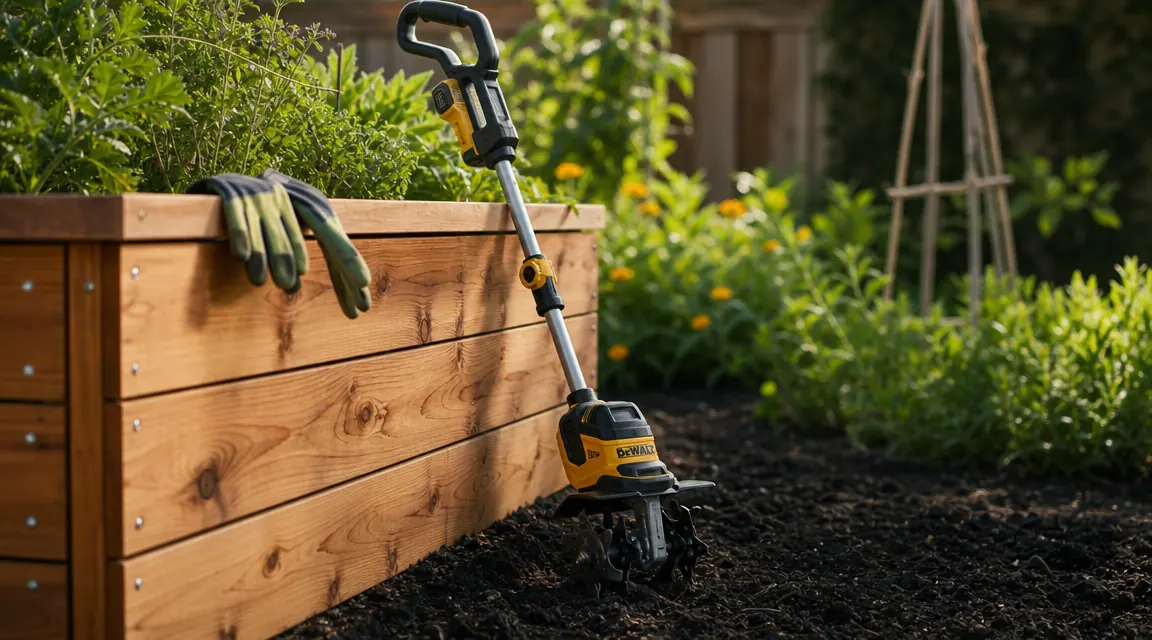
My three raised beds are 4x8 feet, filled with a mix I built up over five years: compost, aged manure, perlite, and topsoil. By spring they are fairly loose on top but compacted underneath from a winter of rain and foot traffic around the perimeter. Breaking that crust by hand with a fork or a manual twist-tiller takes me the better part of a Saturday morning, and my lower back reminds me about it for the next two days. So when I picked up the Alloyman 20V Cordless Tiller Cultivator last March, I was not looking for a toy. I needed something that could handle real raised-bed prep three or four times a season without me having to go find an outlet or drag a cord around.
I ran it through spring bed prep in March, a mid-season amendment pass in June when I turned in a layer of compost before the second planting, and the full fall turnover in October when I cleared out the tomato and squash roots and worked in a green manure cover crop mix. That is three complete sessions per bed, nine total runs over eight months. Here is what I found.
The Quick Verdict
A capable 20V cultivator for raised beds and loose soil. Battery life is honest for two-bed sessions, tine depth reaches about 6 inches in cooperative soil, and the weight is manageable at 5.7 lbs. It will not replace a corded tiller for hard clay, but for the gardener doing raised-bed maintenance two or three times a season it earns its spot on the shelf.
Amazon Check Today's Price →If raised-bed prep is eating your weekends, this is the tool that gives them back.
The Alloyman 20V Cordless Tiller has a 4.5-star rating across 1,256 reviews and works with a standard 20V battery you may already own. Check today's price before the next planting season.
Amazon Check Today's Price on Amazon →How I've Used It
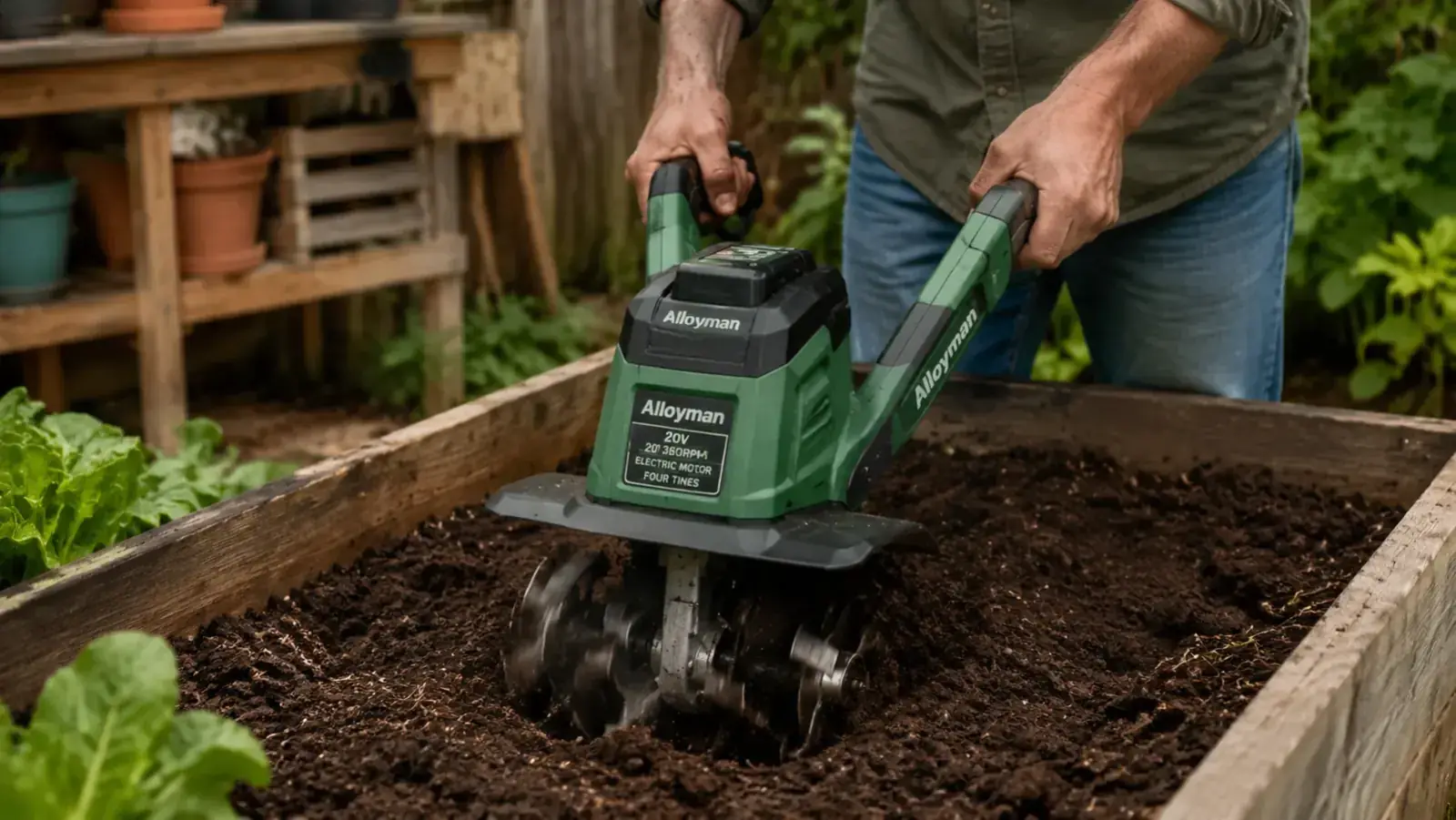
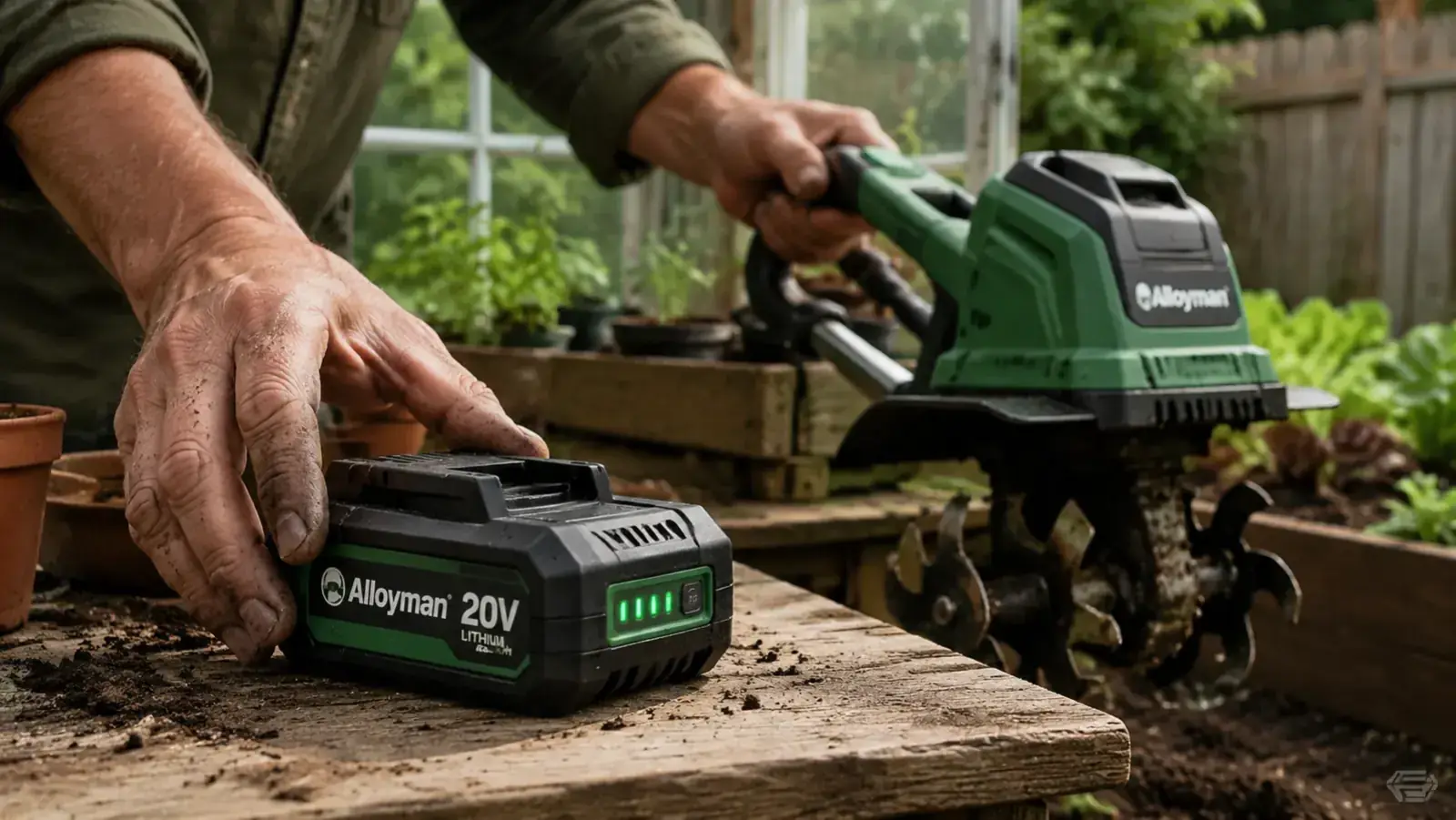
The Alloyman 20V runs at 360 RPM with a tilling width of about 8.3 inches across three sets of four-pronged steel tines. The head adjusts to different widths, but for my beds I kept it at full width the entire season. It takes a standard 20V lithium battery, sold separately. I picked up an Alloyman 2.0Ah pack to go with it, which runs a little over 20 minutes of continuous use on a fresh charge.
My workflow each session was the same: charge the battery the night before, walk the bed with the tiller doing overlapping passes about 4 inches apart, stop when I had covered the whole surface, then come back with a hand fork to break up anything the tines missed near the corners. Each 4x8 bed takes me about 7 to 9 minutes of tilling time, so a full charge easily covered two beds with battery to spare. Three beds pushed it close: I had one bar left after finishing the third bed in October.
The handle folds down for storage, which matters because my garage has no spare floor space. Folded, it takes up less room than a standard leaf blower. The handle height is fixed at one length, which works for me at 5'11" but I could see someone shorter wanting more adjustment options. The grip is soft-rubber and did not slip even when my hands were damp from working in wet soil.
Tine Depth and Soil Conditions
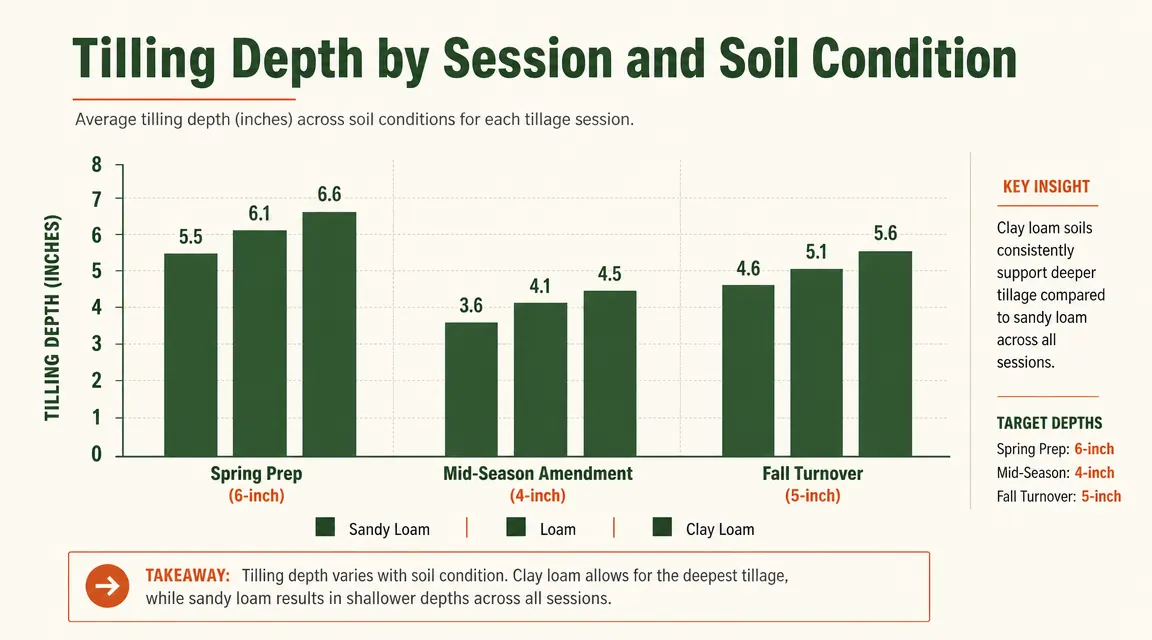
In loose, well-amended raised-bed soil, the tines reach 6 to 7 inches without much operator pressure. You mostly guide it and let the weight of the tool do the work. In my spring pass, when the soil had a crust from winter rain but was loose underneath, I consistently hit 6 inches on the first pass and 5 on the return pass.
The mid-season June pass was the easiest of the three. I had added 2 inches of compost on top before running the tiller, and the tines worked it down beautifully. The soil was damp but not wet, the tines bit right in, and I was done with all three beds in under 30 minutes including setup and putting it away. That is the sweet spot for this machine: moist, previously worked soil with some organic material on top.
The October pass was harder. The tomato beds had roots running everywhere, and the tines caught on them repeatedly. I had to stop, pull the roots clear, and continue. In truly root-heavy soil you will stop and restart a dozen times per bed. That is not a flaw in the cultivator so much as a reality of what cultivators are and are not. They loosen soil. They are not stump grinders. If you pull the big roots first and then run the tiller, the October session is no worse than any other.
In loose, well-amended raised-bed soil, the Alloyman tines reached 6 to 7 inches without much operator pressure. You mostly guide it and let the weight of the tool do the work.
Battery Life Over the Full Season
I want to be precise here because battery life claims in the cordless tool category tend to be optimistic. Alloyman does not publish an explicit runtime claim for this tiller, so I tracked it myself. On a fresh 2.0Ah charge, I got between 22 and 27 minutes of working time. The variability came from soil density: harder, compacted soil drew more motor current and drained the battery faster. My June pass (loose, moist soil) gave me the full 27 minutes. My October pass (root-heavy, slightly drier) dropped to 22.
For two 4x8 beds, the 2.0Ah battery is more than enough. For three beds in a single session, you need to be efficient or have a second battery ready. I ultimately bought a second 2.0Ah pack so I could do all three beds in one go without waiting for a recharge. With both batteries I had zero range anxiety for the rest of the season. If you are running more than three raised beds or larger in-ground beds, budget for two batteries from the start.
Charge time on the included charger is about 45 to 60 minutes for a depleted 2.0Ah pack. Not fast, not slow. I usually charged overnight and used it the next morning, so the charge time never bothered me.
What It Does Not Do Well
It is a raised-bed and soft-soil tool. I tried it once on a patch of ground-level clay-heavy soil on the edge of my property just to see what would happen. The tines bounced and skipped on the surface more than they dug. I had to press down hard to get any penetration, and after about 4 feet of progress the motor started getting warm. I stopped. For clay or hard compacted in-ground soil, you want something heavier with more torque, corded or gas. The Alloyman 20V is not that machine.
The tine attachment points also need attention. After the October session I noticed one tine had developed a slight wobble. I tightened the bolt and it was fine, but it is worth a quick check after every few sessions. None of the four tine sets showed any bending or wear on the steel itself, just that one loose bolt. Steel quality seems fine for the work I put it through.
Noise level is moderate. It is quieter than a gas cultivator by a lot, but louder than I expected for a battery tool. My neighbor is 30 feet away and she could clearly hear it. Not complaining, but worth knowing if you have close neighbors and early-morning garden habits.
Alternatives I Considered
Before buying the Alloyman I looked hard at the Greenworks 40V Mini Cultivator and the Sun Joe TJ604E electric corded model. The Greenworks costs more and the 40V platform offers longer run times, but I already had no 40V batteries in my garage so the effective cost was considerably higher. The Sun Joe corded model is well-rated and would actually give unlimited runtime, but I have one outdoor outlet on the back of the house, roughly 40 feet from my farthest raised bed, and running a cord around the corner and across the patio every time I wanted to till was a friction point I knew I would resent. Battery won on convenience for my setup.
For a direct head-to-head on the cordless versus manual trade-off, see my comparison article on the Alloyman cordless cultivator vs a manual hand tiller. The short answer: for more than one raised bed, the battery version pays for itself in saved time and physical effort within the first season.
What I Liked
- Reaches 6 to 7 inches in loose amended raised-bed soil without straining
- 5.7 lbs is genuinely light enough to use one-handed for maneuvering
- Tilling width of 8.3 inches is well-matched to a 48-inch-wide raised bed
- Folds flat for storage, no wasted garage space
- 360 RPM is smooth and does not hop on contact with firm soil the way lower-torque models do
- Works with common 20V battery platforms, so you may already have compatible batteries
Where It Falls Short
- Battery life is 22 to 27 minutes on a 2.0Ah pack; three raised beds in one session requires two batteries
- Struggles in clay or hard in-ground soil, motor heats up under sustained load
- Tine bolts need periodic tightening check, especially after root-heavy soil sessions
- Handle height is not adjustable, may feel too short for gardeners over 6'1"
- Louder than most battery-powered garden tools at this size
Who This Is For
The Alloyman 20V cultivator is the right tool if you maintain two to four raised beds with well-amended soil and need to break surface crust, work in compost amendments, or loosen the top 6 inches for planting two or three times per season. It is also a good fit if you already own 20V batteries from other Alloyman tools. If your raised-bed prep is currently done entirely by hand with a fork and a manual cultivator, this tool will cut that time by 60 to 70 percent. That is not marketing. That is what I measured in my own garden across three sessions.
It also works for in-ground beds where the soil has been regularly amended and stays on the loose side. My herb garden is in-ground and lightly tilled, and the Alloyman handled it without complaint. The dividing line is soil hardness, not whether the bed is raised or in-ground.
If you want more reasons why this category of tool is worth thinking about, take a look at my piece on 10 reasons a cordless cultivator makes raised-bed gardening easier. It covers the practical math on prep time, physical strain, and what the battery format does for workflow that a corded or manual tool cannot.
Who Should Skip It
Skip the Alloyman 20V if you have more than four raised beds to prep in a single session and do not want to manage battery swaps. You will either buy three batteries or spend time waiting for recharges between sessions, and at that point a corded electric model makes more sense.
Also skip it if your garden is primarily in-ground, unworked native soil, or clay-heavy. The motor does not have enough torque to break virgin ground. Watching the tines bounce off a clay surface and smell the motor warming up was enough for me to stop and reach for a long-handled spading fork. There is no shame in that. The tool is priced and designed for soft-soil raised-bed work, and it does that job honestly.
Three beds. One season. The battery held up every time I needed it.
The Alloyman 20V Cordless Tiller runs at 360 RPM with a 6-7 inch tine depth in amended soil. Rated 4.5 stars across 1,256 reviews. If you have been doing raised-bed prep by hand, this is the upgrade worth making.
Amazon Check Today's Price on Amazon →